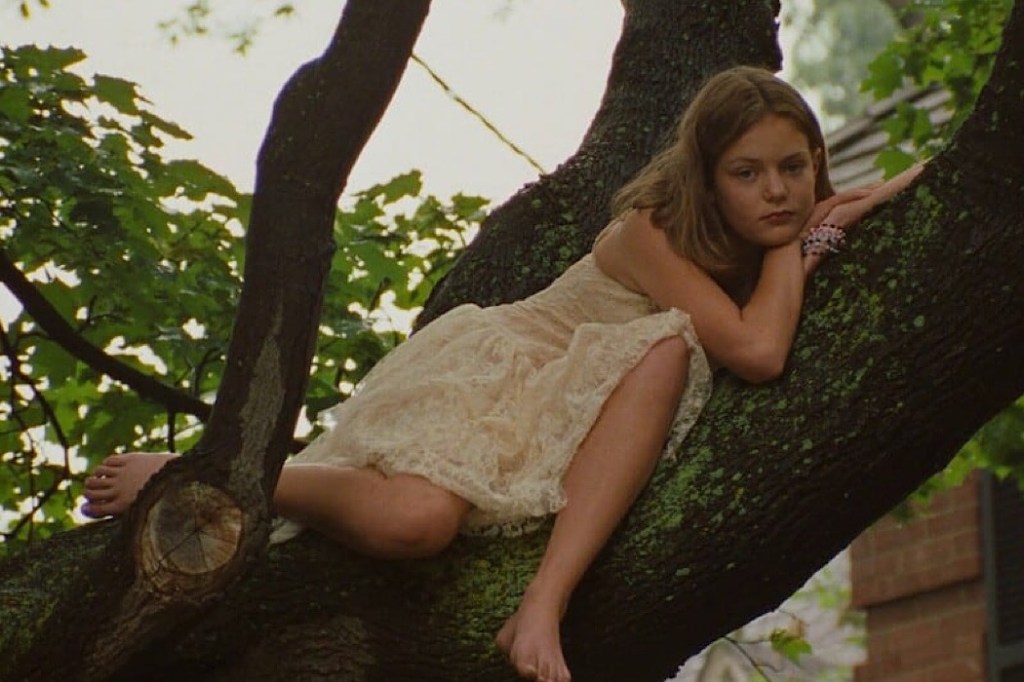
All the movies I’ve seen, good or bad, have been engraved into who I am. Any cinephile can speak to this. They’re transparent tattoos that are a roadmap of my fandom and personality. As I get older and follow the endless yellow celluloid road, more and more are added. Why not start an ode to these lovelies?
The Virgin Suicides is a haunting work of art about the fragility of youth, the enigma of adolescence and the fleeting nature of life. It’s a powerful story and impressive first feature film by the talented Sofia Coppola.
It’s a suburban town in the 1970s. The Lisbon family consisting of parents Kathleen Turner and James Woods and their five daughters: Cecilia (Hanna Hall), Lux (Kirsten Dunst), Bonnie (Chelse Swain), Mary (A.J. Cook), and Therese (Leslie Hayman) reside in a sleepy town. Things seem fine, but when one of the daughters takes her life, the family is devastated.
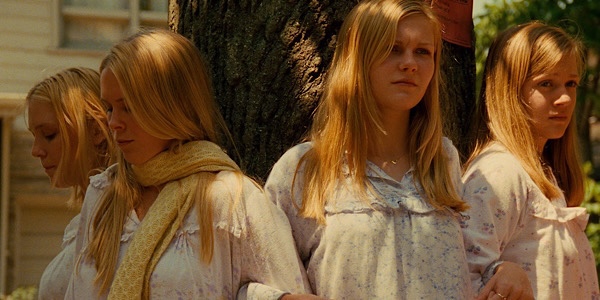
The parents become especially protective of the girls, who yearn to have more freedom. Lux begins a whirlwind romance with Trip Fontaine (Josh Harnett) and gets a heartbreaking introduction to first love. And the growing teenagers are forced to rely on one another, further creating a distance from life outside.
After the girls are grounded they slip into a quiet despair, and their only connection is an exchange of letters and music with a group of neighborhood boys.
And oh, does Coppola nail the soundtrack. Its hypnotizing and effective in filling the permeable silences. The music is a character in and of itself. Each song conveys a thousand thoughts and what it stirs in me, shifts into something new everytime I watch.
It’s got an earnest melancholy that settles in your bones, embeds deep and lingers long. There’s a whisper of the unsettling despair that grows to an outcry, as we hear narration from Giovanni Ribisi (who does terrific voice work) regaling how the young boys in the neighborhood saw the Lisbons.
The boys speak of them like beautiful mysteries, and the film’s bleak outline is painted in a delicate feminine energy with saturated colors of hazy shades. It feels like a lovely daydream that eventually meets a cold reality.
The story of the Lisbon sisters has stuck with me since the first time I saw it. A young girl myself, it spoke volumes to me. No matter how many times I’ve seen it, the feelings it invoked remain present. I’m still that impressionable pre-teen, the love language of cinema sweeping me away, and my heart stolen by this dream like whirlwind of tears and wonder.
It was both terrifying and spellbinding and it showed me how a movie can wrap you in an emotion and keep you there, suspended. A piece of me will always be in that house, yearning to break out.
Sometimes I wish there was more from the girl’s perspective, but the decision enhances the uncertainty, and the nature of perception. There are a lot of intentional details Coppola uses to enhance this. We are meant to watch and not fully understand.
Even from a distance, the film speaks to how women’s and adolescent sadness can be overlooked. The Virgin Suicides is a snapshot, a nostalgic waning of whimsy wondering (and wandering).
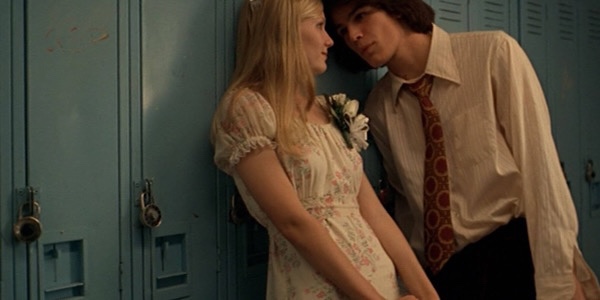
There’s an angelic quality about the girls but also an underlying humanity, deep and dark. The soft focus, beautiful hue of sunshine laden days and lip balm smiles distract from the loneliness and desperation they feel.
It’s cinematography is exquisite and Coppola’s adapted script works to deliver us a fairy tale of woe in just 97 minutes. The excellent performances capture these characters perfectly.
With an impeccable cast and an assured vision from Sofia Coppola, The Virgin Suicides is an indelible cinematic landmark.


Leave a Reply